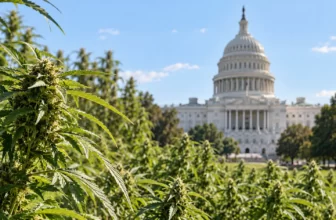
The U.S. Drug Enforcement Administration (DEA) has concluded testimony in its hearing on the Trump administration’s proposal to broadly reschedule marijuana under federal law, with the agency’s chief administrative law judge outlining the next procedural steps before issuing a recommendation. Meanwhile, newly disclosed Federal Election Commission (FEC) filings show that several of the country’s largest cannabis companies collectively contributed $11.5 million in June to a political committee linked to President Donald Trump.
DEA Hearing Concludes, Post-Hearing Briefs Due In August
The multi-day DEA hearing, which began in late June, concluded after testimony from participants opposing the broader marijuana rescheduling proposal.
Following the conclusion of the hearing, DEA Chief Administrative Law Judge Derek Julius ordered participating parties to submit optional post-hearing briefs by August 17. The briefs, which may be up to 50 pages long, can include closing arguments and address other issues raised during the proceedings. Participants may also submit proposed corrections to the hearing transcripts by the same deadline before a corrected version is published on the agency’s website.
After reviewing the submissions, Julius said he will prepare a recommendation on whether the government should move forward with broader marijuana rescheduling. The recommendation will be sent to DEA Administrator Terrance Cole, who will make the final decision. Julius did not provide a timeline for either his recommendation or the administrator’s decision.
During the hearing, DEA officials defending the proposal presented testimony regarding marijuana’s medical benefits and its relative safety compared with substances including alcohol and opioids. Witnesses included a Food and Drug Administration (FDA) scientist and a physician from New Hampshire who testified about medical cannabis as a treatment option for pain patients and as an alternative to opioids.
Opponents of the proposal focused on the alleged harms associated with cannabis use and criticized changes to the analysis used to determine whether a substance has an accepted medical use.
Campaign Finance Filings Show $11.5 Million In Cannabis Industry Contributions
As the rescheduling process moves forward, newly updated FEC filings show that several major U.S. cannabis companies made contributions in June to America First Agriculture Action Inc.
According to the filings, Trulieve Inc., Curaleaf Inc., Verano Holdings LLC and Vision Management Services LLC, a subsidiary of Green Thumb Industries, each contributed $2.5 million. Arboretum Bidco LLC, a holding company tied to AYR Wellness Inc., contributed $1 million, while Ascend Wellness Holdings Inc. donated $500,000.
The contributions total $11.5 million.
The agriculture-focused political committee shares its treasurer, Charles Gantt, with Trump’s super PAC, MAGA Inc. Previous contributions from cannabis businesses and an industry-backed political action committee bring the total amount donated to Trump-linked political committees to at least $15.05 million.
Rescheduling Process Continues
The campaign finance filings were disclosed weeks after the Department of Justice announced it was moving forward with the federal marijuana rescheduling process.
In April, Acting Attorney General Todd Blanche issued an order immediately moving marijuana products regulated under state medical cannabis programs, as well as FDA-approved marijuana products, from Schedule I to Schedule III of the Controlled Substances Act. The hearing that has now concluded is considering broader marijuana rescheduling, including recreational products.
America First Agriculture Action Inc. has previously released advertisements highlighting President Trump’s support for cannabis rescheduling during his 2024 campaign and urging the administration to complete the process.
The current rescheduling effort follows an earlier process initiated during the Biden administration that stalled amid litigation over alleged improper communications and witness selection. The current proceedings are also being challenged through lawsuits filed by state attorneys general, marijuana legalization opponents, and a cannabis-focused biopharmaceutical company.
What Happens Next?
The next step in the DEA proceedings is the August 17 deadline for designated parties to submit optional post-hearing briefs and proposed transcript corrections.
After reviewing those materials, Judge Julius will issue his recommendation on the proposal. DEA Administrator Terrance Cole will then decide whether to accept or reject the recommendation as the federal marijuana rescheduling process continues.

Rita Ferreira
Rita is a seasoned writer with over five years of experience, having worked with globally renowned platforms, including Forbes and Miister CBD. Her deep knowledge of hemp-related businesses and passion for delivering accurate and concise information distinguish her in the industry. Rita's contributions empower individuals and companies to navigate the complexities of the cannabis world, and her work remains a valuable resource for those seeking a deeper understanding of its potential.